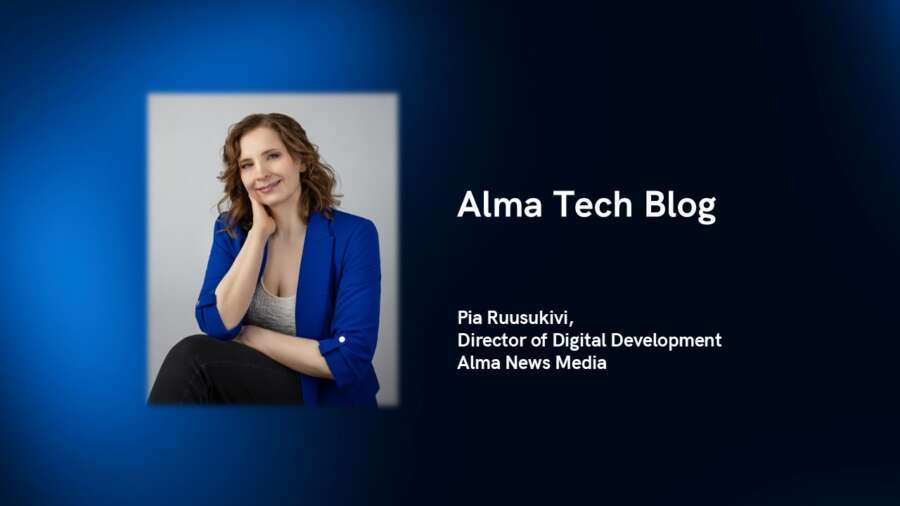
Change is not a project – It’s a mindset
Looking back at the history of digital development at Alma Media, one thing becomes clear: very little has stayed the same for long. Technologies, roles, and ways of working have continuously evolved, and so has our understanding of what makes sense at any given moment.
At Alma, change has never been a one‑off transformation program. It has been a constant state.
Over time, the ability to reassess our own choices, let go of solutions that still work, and rebuild when needed has become part of how digital development is done. These lessons were not learned from frameworks or playbooks, but from everyday work. Often through trial and error.
Our digital journey began already in the 1990s with early online services such as Iltalehti Online and Kauppalehti Online. Alma has since evolved into a product‑ and technology‑driven organization where more than 100 digital services are developed in‑house.
Here are a few observations from different phases of that journey that have shaped both my thinking and Alma’s approach to change.
When everything had to be built in‑house
We entered digital business early—early enough that many of today’s standard tools and SaaS solutions simply did not exist. Content management systems, ad management platforms, and identity solutions often had to be built by ourselves because there were no viable alternatives.
This was not ideology; it was necessity. And it taught an important lesson: there is no universal “build vs. buy” answer. What makes sense depends on the maturity of the market, the lifecycle of the service, and where competitive advantage is created at that point in time. A decision that is smart in one phase can easily become a liability in the next.
From individual heroes to teams, and toward broader skill sets again
Early in my career, a single person often did work that today is handled by several specialists. Development was highly person‑dependent. Over time, we moved deliberately toward team‑based work and specialization. This improved quality and resilience, but also increased complexity.
With AI, we are entering yet another shift.
Some specialist boundaries are beginning to blur, and individual impact can grow again with the right tools. I don’t believe we are returning to the old “hero developer” model, but I do believe generalist thinking is gaining new relevance. AI does not replace thinking; it raises the bar for it.
Our teams use a wide range of AI tools in their day‑to‑day work. Tools such as Cursor, Claude, and CodeRabbit are already part of our everyday development practices. This year, our focus is on building automation and AI‑powered workflows that make teams’ work easier and more efficient.
The rise of design, product thinking, and data
One of the most meaningful changes has been the rise of design and product thinking as core capabilities. I remember when usability and design were often side responsibilities of frontend developers with a good visual eye.
Hiring our first designer who did not write code felt like a big step at the time. In hindsight, it marked a deeper shift: recognizing that value is not created only in implementation, but in how problems are framed and solutions shaped from the user’s perspective.
Today, we are exploring how design systems combined with AI can dramatically shorten the path from experimentation to production‑ready code. In parallel, data expertise has grown into a strong discipline of its own—and its importance continues to increase.
Currently, Alma Media employs more than 600 technology and product development professionals across 10 different countries. Of these, nearly 50 work in design roles, more than 75 in data‑related roles, and close to 90 in product management and related positions.
From our own hardware to the cloud
Moving from on‑premise infrastructure to the cloud was one of our biggest technological shifts. It was not just an infrastructure change, but a move to modern architectures that required rebuilding a large part of our services.
Alma has been an early and extensive adopter of cloud services, especially AWS. Over the years, we have even had the opportunity to spar with AWS development teams about where we hope their services will evolve.
The key lesson was simple but demanding: true change readiness requires the willingness to rebuild, even when existing solutions still function. Waiting rarely makes technical debt disappear.
Ways of working must evolve as well
I started in a world where work was highly person‑dependent. Moving to agile ways of working was challenging at first, but we approached it seriously. We began with “pure” Scrum and invested in experienced support to learn the practices properly.
Since then, we have evolved toward more flexible combinations of Kanban and Scrumban. Our teams work in DevOps models, owning both development and operations. Processes are tools, not identities.
Now, with AI widely used across teams, we are again rethinking how work can be done—faster, with higher quality. We are not looking for silver bullets, but for the next improvement.
Change readiness is built over time
Across all these phases, one thing connects them: change has never been a single event. Change readiness is built through repeated reassessment, experimentation, and the courage to change direction.
Alma’s digital development has not followed a straight line, but a series of deliberate turns. I believe this mindset, continuous learning combined with pragmatic decision‑making, is what prepares us for the future, at a time when the pace of change is only accelerating.
Change is not a project that gets completed. It is a mindset that needs to be practiced every day.
And personally, it has been a privilege to be part of this journey: a journey where you are continuously encouraged to reinvent yourself, rethink how work is done, and keep learning something new along the way.
About the author:
Pia Ruusukivi is Director of Digital Development at Alma News Media, where she is responsible for development teams working for several of Finland’s leading media brands. With more than 25 years at Alma Media, she has built her career at the intersection of journalism, technology, and business, playing a key role in the company’s long‑term digital transformation.
Currently, Pia leads a technology organization of more than 75 professionals. Her focus is on creating measurable business and user value, supporting subscription and advertising growth, and building sustainable development practices in a complex media environment. She holds academic degrees in business communication and computer science.
- Julkaistu: 21.4.2026 klo 10:36
- Kategoria: News
- Teema: Alma Developers, Working at Alma