Courage grows together.
Strategy
Our strategy is focused on the customer, improving the customer experience and creating value for all our stakeholders. The three focus
areas are: 1) transformation, 2) growth, and 3) scalability.
Three focus areas of the strategy
1. TRANSFORM
- Streamline customer processes by integrating services to platforms
- Increase operational agility to speed up time-to-market
- Advance customer-centric, product-led development with AI
2. GROW
- Increase customer value and diversify revenue streams
- Develop the best human and technology capabilities
- Accelerate growth through M&A
3. SCALE
- Scale existing assets to create new products and services
- Expand businesses to new geographies
- Leverage synergies through efficient co-operation
Alma Media’s strategy is built on the ambition to evolve from a media company into a provider of advanced platform solutions across marketplaces, media and information services. The company focuses on business areas where it can deliver clear added value to end customers and where its competitive advantages enable profitable growth. Growth is pursued both organically and through acquisitions, while operations are expanded into carefully selected new geographical markets. At the heart of the strategy is broadening the company’s role in value chains and building service ecosystems in which Alma Media’s and its customers’ technical and commercial platforms integrate into a seamless and scalable whole that enhances customer experience and improves the efficiency of corporate customers’ digital processes.
The current strategy is anchored on three pillars: transformation, growth and scalability. Transformation means enhancing customer processes by turning services into platform‑based solutions, improving products and services through the use of artificial intelligence, and increasing agility so that new solutions reach the market faster. In terms of growth, the strategy focuses on building diversified revenue streams, strengthening technological and human capabilities, and utilising acquisitions in areas where the company can complement its offering. Scalability leverages the group’s strongest capabilities and synergies, builds new products and services from existing strengths and expands into new markets in a controlled and disciplined manner.
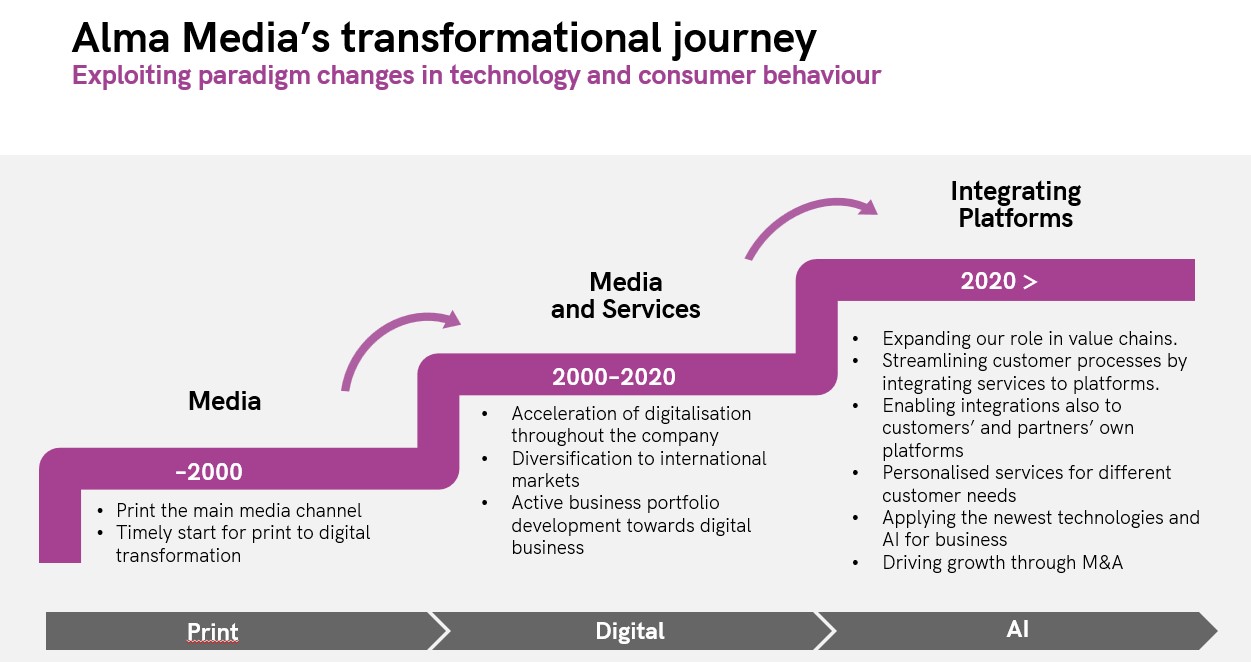
This strategic foundation is the result of a determined transformation journey spanning more than two decades. Alma Media began its digitalisation already in the late 1990s, when the online versions of Kauppalehti and Iltalehti were launched. At the turn of the millennium, digital business accounted for only a few percent of revenue, but the company recognised early on that consumer behaviour and the structures of the media industry were about to change. Print remained the dominant channel, but the early stages of digitalisation initiated a long development arc in which investments in digital services, platform solutions, marketplaces and data capabilities laid the foundation for future growth. In parallel, the company systematically invested in marketplace businesses and gradually divested operations that no longer supported its long‑term digital strategy.
A major turning point came in 2020, when Alma Media sold its remaining regional and local newspapers. This accelerated the company’s shift away from a print‑ and publishing‑driven model toward an international provider of digital services and platform solutions. The company moved from individual products and services toward integrated platform models in which marketplaces, media and information services were developed to reinforce one another. As a result, the share of digital business grew rapidly and the share of traditional media decreased. Strategic transactions, such as strengthening marketplace businesses and expanding recruitment services internationally, further deepened the transition toward a new strategic identity.
Artificial intelligence has now been elevated to a shared strategic priority across the group. AI is used to accelerate product and service development, improve internal processes and strengthen operational agility. The aim is for AI to support the development of every business area systematically, enabling the creation of entirely new solutions as well as qualitative and efficiency improvements to existing services. Audiences form another strategic priority, and their growth, engagement and unified utilisation support scalability across the company. The rapid advancement of AI is fundamentally reshaping the entire industry, and Alma Media seeks to harness its full potential in all operations.
The strategy is visible in the day‑to‑day work of each business segment. In recruitment services, AI‑based matching and automation solutions are developed and scaled for international markets. In marketplaces, the shift has progressed from classified listings to transactional platforms that support customers’ buying and selling processes throughout their lifecycle. Information services rely increasingly on data, analytics and automated decision‑support solutions. In news media, the transformation is reflected in the shift to a fully digital model, personalised content, dynamic paywalls and AI‑assisted editorial processes that improve both efficiency and user experience. What unites all segments is that platforms, data, audiences and technological capabilities form the backbone on which growth and profitability are built.
The company’s strategy aligns with a broader ambition to accelerate sustainable growth for individuals, businesses and society. Group‑level management and planning practices ensure that the strategy is implemented consistently across segments and translated into both team‑level and individual objectives. This creates a coherent pathway where the group’s strategic vision, business‑specific plans and daily activities reinforce one another. Shared development initiatives, such as the AI programme, audience strategy and unified platform solutions, enhance competitiveness in a market that is evolving faster than before and in which scalable, platform‑driven models are set to win. Alma Media continues its long‑term strategic journey toward becoming an international technology‑driven platform company.
Read more about Alma Media long-term financial targets.
Business model
Alma Media has business operations in three business and reporting segments:
- Ama Career
- Alma Marketplaces
- Alma News Media
Alma Media’s sources of revenue are:
- classified advertising,
- advertising,
- digital services,
- content,
- other sales.
The revenue categories listed above comprise several different revenue generating models. The media sector’s historically clear division between circulation sales and advertising sales has become diversified as a result of digitisation.
Description of the business model
As the digital transformation has progressed, digital marketplaces have become an increasingly significant area of Alma Media’s business. They include services related to recruitment, housing, cars and mobility, for example. The customers of Alma Media’s digital services include both companies and consumers. The digital services business model is based on customer fees charged for classified advertising, fees for increased visibility in classified advertising, service sales, revenue streams from service content and/or advertising targeted at the users of the service, subscription fees and licence fees for the use of information systems.
The media business includes, for example, the professional and financial media and books as well as the national multichannel media Iltalehti. The media business is based on a relationship with readers built through content. As media develops, the reader relationship is shaped into a multidimensional customer relationship with a media brand. The strength of this relationship can vary from occasional visitors or buyers of single copies to the use of online services as registered users of online services, paying consumers of digital content and long-term subscribers of print publications.
The Group’s other services include information services as well as training, event and direct marketing business.
For all businesses, readers and online visitors constitute target groups that are characteristic to each brand. These target groups are the basis for advertising sales. These target group contacts are sold to advertisers on a brand-specific basis and as audience segments from the digital Alma network. For advertisers, this opens up valuable opportunities to specifically target the businesses, professionals, decision-makers, entrepreneurs or consumers that are relevant to the growth of their business. The use of data, analytics and machine learning plays an increasingly important role in improving the product and service offering for advertisers and enriching the end-user service experience. Data and marketing automation enable the provision of increasingly high-quality, effective and impactful solutions to advertisers.
Brand appeal and the communications and marketing efforts aimed at maintaining it are crucial in the digital environment. Alma Media’s services are the best-known brands in their segments in Finland and the Group’s operating countries in Eastern Central Europe. The popularity of these services among users is based on a high level of usability, unique content and, in many cases, the importance of the social or communal dimension. It is also essential to have the ability to respond to customer needs by delivering localised products and services.
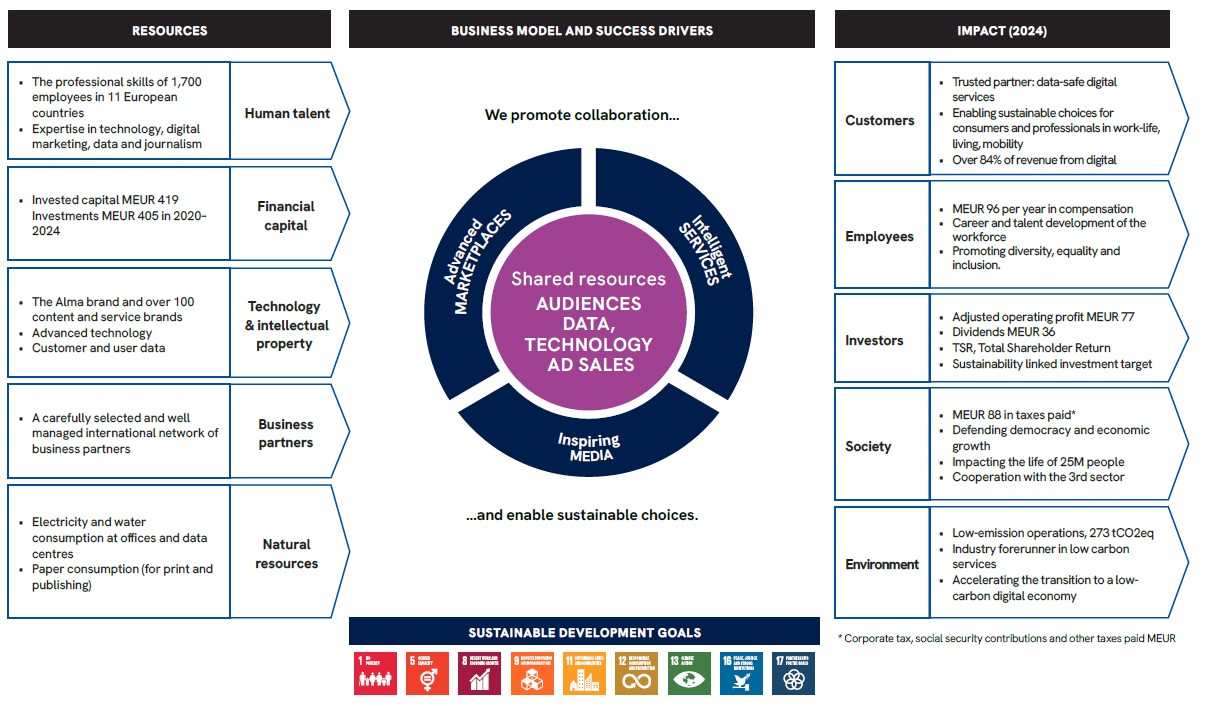
Value creation
In Alma Media’s value creation for customers, shareholders and society, the key roles are played by the strong journalism, marketing and technology expertise of the Group’s employees, strong product and service brands, customer data, the best partners, an efficient production and delivery network and a stable financial position. These are described in more detail in value creation model.